
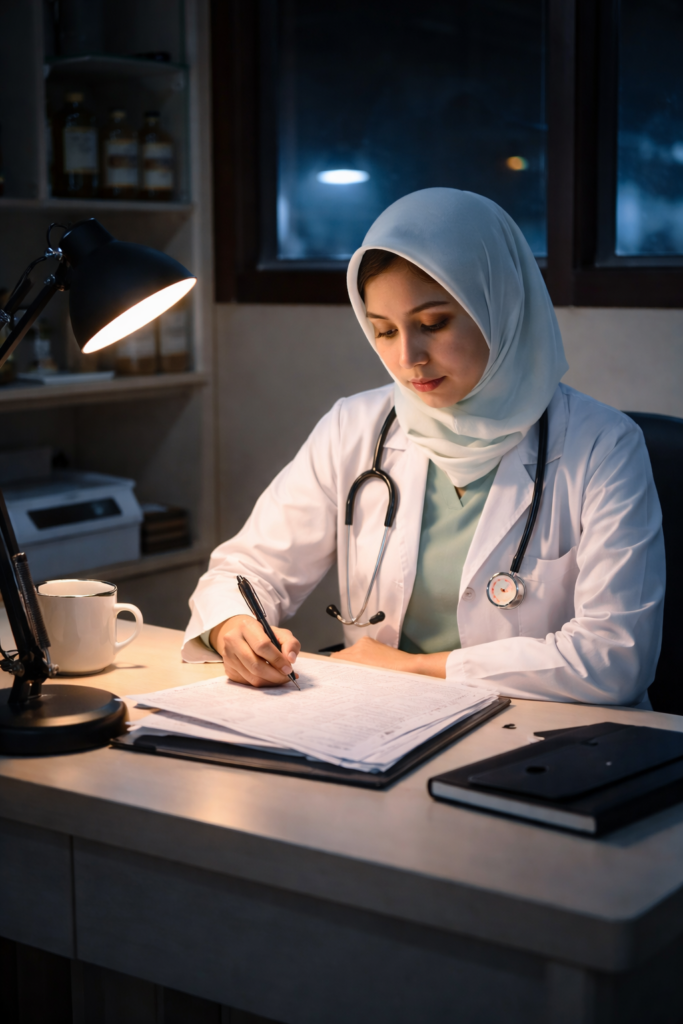
It was 2 am when a patient’s room bell rang.
We rushed in to find a woman struggling to breathe, wheezing constantly, trying to catch her words between gasps. She had been suffering from asthma for years and used a Foracort pump, a combination bronchodilator inhaler regularly. But the day she was admitted, she had already used it four times instead of the prescribed once.
Decoctions were prepared. Under the senior physician’s guidance, we performed sthanik snehan (local application of medicated oil) and swedan (therapeutic steam). These are Panchakarma procedures; a core set of Ayurvedic detox and healing therapies.
I waited.
The wheezing continued.
What People Imagine an Ayurvedic Hospital to Be
When someone says they work in an Ayurvedic hospital, most people don’t quite know what to picture. The brain jumps between the fast-paced emergency rooms of House M.D. and the image of a traditional vaidya (physician) grinding herbs on a stone slab. Surely there must be some modern intervention? Maybe it only handles chronic cases like arthritis or gut issues? Or is it just Panchakarma retreats?
Where I worked, yes, we saw chronic cases and Panchakarma admissions; but we also managed patients with cancer, asthma, fracture, road traffic accidents with amputated toes, subarachnoid brain hemorrhage, facial paralysis, chronic back ulcers, paralytic ileus, Duchene muscular dystrophy, rheumatic heart disease and so on.
So how does that work without modern medicine?
Treatment and diet are both Ayurvedic. Panchakarma procedures and rasa aushadhis (mineral and metal-based Ayurvedic formulations) are used to manage even severe conditions. For every clinical situation, there is a combination of internal medication and external procedures. A headache might be treated with shirolepa (herbal paste applied to the head), shirotalam (oil pooling on the scalp), or nasya (nasal administration of medicine). Basti (medicated enema), udar lepa (abdominal application), phalavarti (suppositories), anjana (eye treatments), snehan and swedan are done as required and many other types of panchakrama are done.
At the same time, modern monitoring is used; BP, pulse, blood sugar, relevant lab tests. RT tubes (naso-gastric feeding tubes) and urinary catheters are inserted when needed. Oxygen is administered when required. Ongoing modern medications for BP, thyroid, or diabetes are not discontinued. In case of a fracture, traction is also given and appropriate bandaging to immobilize the joint is done.
Diet, too, is medicine. Chronic alcoholics admitted with liver cirrhosis or udar roga are kept on an only milk diet. Others too get a carefully designed diet with moong bean soup, rice water, buttermilk and many more, alongside medication.
What Night Duty Shows You
Being a night doctor opens a window not just to people’s disease, it opens a window to their lives.
You see someone on chemotherapy, their cognition fogged (a phenomenon known as chemo brain), acting irritable or withdrawn. Someone gripping your hand during the worst bouts of pain. Someone sitting up at 3 am, narrating their story to you simply because you’re there.
You understand how deeply a disease can alter everyday life. A person who loves classical singing, unable to sing. Someone who loved to cook, unable to stand or sit because of cancer. A patient who can’t travel anywhere because movement worsens their condition.
Families and Caregivers
You also witness how people respond when someone they love is sick. Some sink into the reality of it completely; others pull away.
A patient with stage four pancreatic cancer, 84 years old, was on end-of-life care in our hospital. When she finally passed, the announcement was for the consultant to make, but it was fairly evident. Her son kept calling out her name again and again, looking for any sign.
Another patient with liver cirrhosis had come all the way from Jammu with his wife and two brothers. The way they helped him every time he needed to get up, sit, or walk to the bathroom is something I’ll always remember.
A middle-aged woman with colon cancer could barely eat and was often nauseous after chemotherapy. Her husband held her every time she was in pain.
Witnessing this firsthand made me understand how much caregivers carry : quietly and continuously.
And then there are patients who, despite having family, are left largely unattended. Professional caretakers working 24-hour shifts cannot always offer what a family can. This leaves patients more vulnerable, often seeking extra attention from healthcare workers just to feel less alone.
My Experience as a Night Duty Doctor
As a resident, you know that in emergencies the attending physician is ultimately responsible; reachable on call and physically present if needed. But knowing that doesn’t dissolve the sense of personal responsibility you feel the moment a patient looks at you for answers.
Whether it was a high fever to monitor, a patient on oxygen whose saturation needed checking, someone in severe pain from cancer metastasis, or simply chest burn and sleeplessness: they all looked at you.
Different patients called for different reasons. One with severe stomach ache would wail through the night with no clear modern diagnosis; she needed management hour by hour. Another, with a chronic ulcer on her back and severe leg pain, would call me for a leg massage sometimes four times a night. Sometimes there was a night protocol for it; often, there wasn’t. So you assessed the severity, gave what medicine you could, called the physician only if truly necessary; and in doing so, you learned a great deal.
It also built endurance. Getting up in the middle of the night, staying alert, appearing confident enough that the patient could trust you and go back to sleep. Some patients were considerate and called only when genuinely needed. Some would call at any hour for any reason. You learned to manage both.
Returning to That Night
I waited almost an hour.
The intensity of the attack reduced, but the patient couldn’t sleep. Eventually the Foracort pump was used, and she finally drifted off.
I remember feeling like we had failed in the face of an emergency.
But the next day, she had another attack. A different physician adjusted her Ayurvedic medications with no Panchakarma this time and the attack subsided. She didn’t need the pump for the next two days. The regular treatment was starting to work from the ground up.
The Limits
Like any system of medicine, Ayurveda does not claim to cure everything. In this patient’s case, it helped reduce the frequency and intensity of asthma attacks and extended the intervals between pump use ; treating the condition at its roots rather than just managing symptoms.
Many people come to Ayurveda as a last resort, when the prognosis is already very poor. In such cases, the goal shifts: you use the tools available to make life a little better, even when the disease itself cannot be reversed.
Sometimes this requires a longer hospital stay, which patients may not be willing to commit to. Sometimes they shift to a modern hospital and that is entirely their right. A good consultant, as I often saw ours do, would advise shifting to allopathy when he genuinely felt it was the better option at that moment. Not out of inadequacy, but out of the patient’s interest. Bypass surgeries, for instance, cannot be replaced.
But Ayurveda can fill real gaps and also treate acute conditions like dengue, chikungunya, typhoid, diarrhoea, and even fractures, while sparing patients the side effects that often accompany long-term modern medications and the treatment cascades that can follow.
To End With
It was never about which system of medicine is superior. As a society, we need both; working alongside each other rather than in opposition. The goal is a world where people receive treatment that addresses the root cause, not just the symptoms. And where the choice of how to get there is made thoughtfully, by physicians and patients together.
Absolutely true.. both pathies should go together to treat a patient.. nicely written
Very nicely written.We are doing this in ur daily duties …but when we think about the moments ..all these patient doctor moments that we have faced will be remembered for lifetime! The assurance..the support .the love that they are seeking from a doctor..is the thing which pushed us to persue this degree of medicine! Health over anything!!!
Very well said Mansi !!
Excellent 👌🏻