
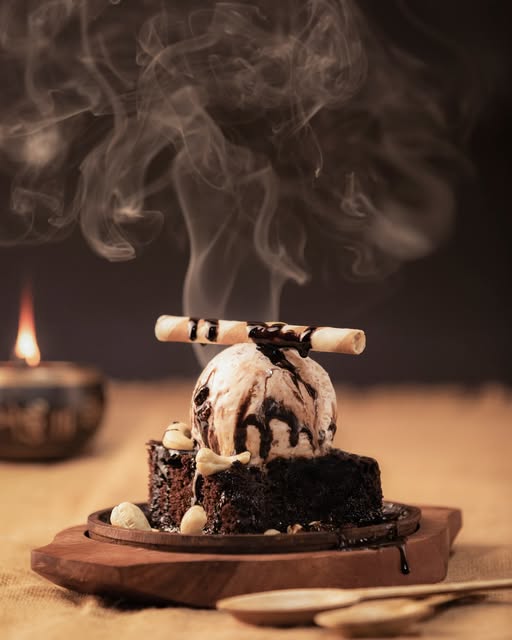
You’re sitting in a restaurant, and the waiter brings out a sizzling hot chocolate brownie with a scoop of cold vanilla ice cream melting on top. Everyone at the table drools with its fragrance and sound, all of it inviting you towards the brownie, even if some other table has ordered it. But for Ayurveda, this is a classic case of Viruddha Ahara: hot and cold, opposite qualities colliding in one plate.
Now you may ask, what is Viruddha Ahara? Don’t worry, we’ll get there. But first, let me confess something.
Because honestly, my story didn’t begin with fancy brownies.
Since childhood, I usually finished my whole Parle-G packet dunked in chai (with milk). Shikran—banana mashed in milk, was my favourite summer breakfast. If I was bored, I’d pull out whatever was in the fridge: be it days-old chicken curry made with yoghurt, or processed foods. My stomach was a dustbin. And over the years, that “anything goes” approach to eating led to health problems; the root of which I only understood after coming to Ayurveda.
That’s when I learnt: food isn’t just about taste. The wrong combinations of foods that are individually good can slowly turn into poison for the body. Ayurveda calls this Viruddha Ahara.
What is Viruddha Ahara?
Ayurveda explains that food can be “incompatible” not just because it’s stale or unhealthy, but because certain combinations disturb the balance of our doshas—Vata, Pitta, and Kapha.
Now here’s the key:
Viruddha Ahara doesn’t immediately throw you into illness. Instead, it causes utklesha of the doshas—it agitates and provokes them, but without giving the body a way to release or balance them. Think of it as shaking up a closed soda bottle, pressure builds inside it but has nowhere to escape.
Everyday Viruddha aahar Mistakes We All Make
We all do it without thinking:
- A bowl of hot soup followed by an icy cold drink at a wedding.
- Honey and lemon in steaming hot water.
- Banana or chikoo milkshake on a summer afternoon.
- Tea with salty biscuits or namkeen (milk + salt).
- Rasmalai or kheer right after a heavy meal.
- Ghee and honey in equal proportion.
Sounds familiar? That’s because most of these have become “normal” habits.
Why They’re Harmful (Ayurveda + Modern Science)
1. Milk + Biscuits (or Tea + Savoury Snacks)
Ayurveda: Milk is sweet, cooling, heavy. Biscuits/tea are processed, salty, sour, fermented—opposite qualities clash.
Science: Refined carbs + dairy protein slow digestion, cause fermentation.
2. Banana + Milk (Fruit Milkshake, Shikran)
Ayurveda: Bananas are sour-sweet, heavy and heating; milk is cooling and heavy. Together → confusion for Agni, producing Ama.
Science: Fruit acids + milk protein curdle in stomach → indigestion, gas, heaviness.
3. Honey + Hot Water
Ayurveda: Honey should never be heated. It becomes toxic, sticky, blocking subtle channels (srotas).
Science: Heating honey destroys enzymes/antioxidants and forms HMF, a potentially harmful compound.
The Modern “Fusion Mess”
Turn on any food show today and you’ll see chefs throwing ingredients together with zero thought about consequences—only taste and looks matter. But for the body, it’s often a fusion mess of Viruddhas.
Think about it:
- French toast drizzled with honey and fruits (honey should never be heated, milk + fruit combo is wrong).
- Fish in creamy cheese sauce.
In one plate, you have desha viruddha (wrong for the body’s environment), satmya viruddha (wrong for your individual adaptation), and virya viruddha (opposite potencies like hot and cold) all together—a perfect recipe for gut chaos.
Other Types of Viruddha
Ayurveda also describes Viruddha beyond just food combinations:
Desha Viruddha – Food unsuitable to the region. (Example: very heavy, oily foods in hot, humid coastal climates.)
Kala Viruddha – Food unsuitable to the season or time. (Example: eating curd at night or in monsoon, cold drinks in winter.)
Satmya Viruddha – What may suit one person doesn’t suit another. (Example: some thrive on milk, others get bloated instantly.)
Matra Viruddha – Wrong quantity. Even good food in excess is harmful.
Virya Viruddha – Opposite potencies in one plate, like hot brownie + ice cream.
In today’s world, all of these overlap. Think of a summer wedding: heavy fried starters (matra viruddha), soup + cola (virya viruddha), curd-based gravies (kala viruddha), and desserts all stacked on one plate
What Can Viruddha Ahara Actually Cause?
Ayurveda doesn’t just say “don’t eat this” without reason. The classics go as far as listing dozens of diseases that can trace their roots to wrong food combinations. From skin issues like eczema, vitiligo, and stubborn rashes, to digestive conditions like bloating, acidity, IBS, or piles… even chronic disorders like anemia, infertility, respiratory problems, mental imbalance, and in severe cases, life-threatening illnesses.
Sounds dramatic? Maybe. But think about it—our daily habits are small, but their cumulative effect is big. If food can be medicine, it can also be slow poison when eaten in the wrong way.
But Wait—Why Don’t We Fall Sick Immediately?
This is the question everyone asks: “But I have chai with biscuits every day. Chicken is always made with curd. Nothing happens!”
Here’s the truth: disease isn’t usually caused by one wrong meal. It’s a cumulative toxin build-up over time.
If your digestive fire (agni) is weak, these toxins accumulate faster.
If you exercise (vyayam) regularly and have strong agni, sometimes you can digest even a stone—such people remain untouched for years.
But eventually, when multiple factors add up—wrong food, stress, sedentary lifestyle—the body tips over into imbalance. That’s when the symptoms appear, often years after the habits have become routine.
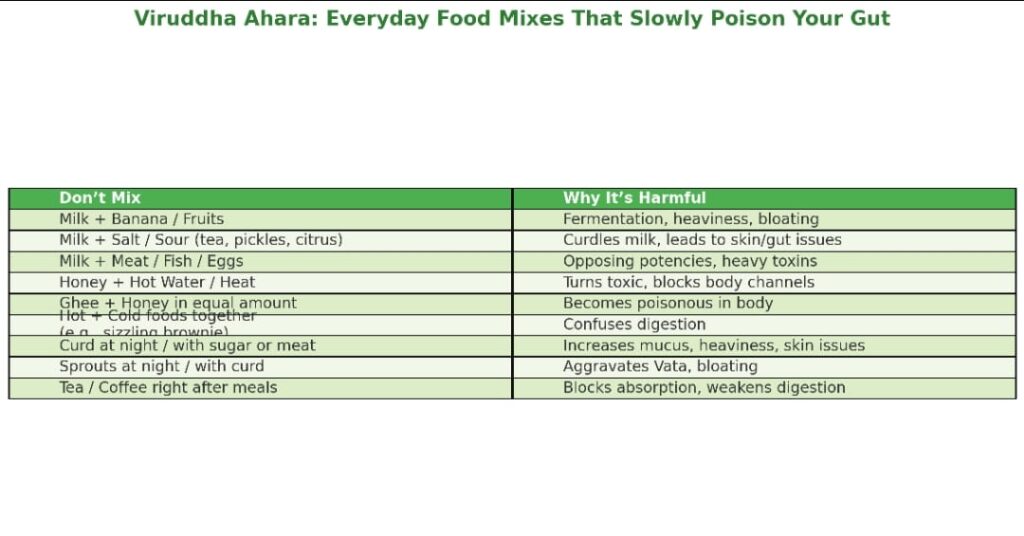
Here’s a recap of Viruddha Anna and its effects on the body:
Final Takeaway
Viruddha Ahara isn’t just some ancient theory—it’s a lived reality. Every time we casually dunk a biscuit in chai, grab ice cream after curry, or copy a chef’s fusion mess, we’re creating tiny toxins that pile up silently.
So here’s a small challenge:
This week, pick one Viruddha habit you do daily and stop it. Notice how your gut feels, how your body changes. Ayurveda is not about restriction—it’s about alignment. And when your food aligns with your body, healing begins naturally.